
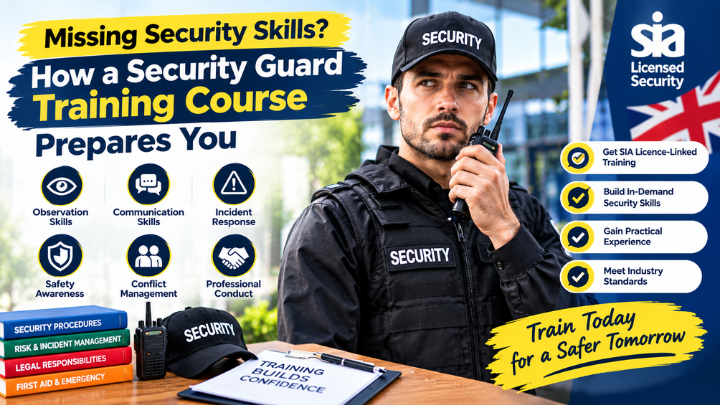
Security work requires more than monitoring people and property. A security guard training course helps learners develop skills in observation, communication, incident response, safety, and professional conduct. For those pursuing a front-line UK security role, SIA license-linked training provides the required core knowledge before applying for an SIA license. As requirements can change, learners should check the latest SIA guidance and course requirements before enrolling.
1. What Security Skills Can You Develop Through Training?
A security guard needs more than an interest in protecting people and property. Professional training helps learners understand the responsibilities, procedures, and practical skills involved in carrying out security duties safely and appropriately. A security guard training course can cover security industry knowledge, incident response, observation, reporting, communication, conflict management, emergency procedures, and relevant legal responsibilities.
Structured training also helps learners understand when they should observe and report an issue, communicate with others, follow site procedures, escalate a situation, or seek assistance. This is important because security personal must work within the responsibilities and limits of their role rather than attempting to handle every situation independently.
These skills can be relevant across UK security environments, including retail premises, construction sites, offices, warehouses, events, and other controlled locations. While the specific duties can vary between workplaces, strong observation, communication, reporting, and professional conduct are valuable foundations for many security roles.
Why Communication and Conflict Management Matter
Clear communication can help security personal deal with people professionally and reduce the risk of misunderstandings during difficult situations. Training can develop skills such as active listening, calm communication, appropriate questioning, maintaining professional boundaries, and recognizing when an incident should be escalated or referred to the appropriate person.
Conflict management is also included within the SIA license-linked training requirements for security guards. Learning how to communicate appropriately during challenging interactions can help security personal respond in a controlled and professional manner while considering their own safety and the safety of others.
2. How a Security Guard Training Course Builds Workplace Readiness
A security guard training course connects essential industry knowledge with the practical responsibilities that security personal may encounter at work. Rather than focusing only on theory, effective training helps learners understand how to apply procedures, communicate appropriately, document incidents, and maintain professional standards in different security environments.
Workplace readiness can involve several important areas:
- Following site procedures: Security personal need to understand and follow workplace instructions, access-control procedures, emergency protocols, and other site-specific requirements.
- Accurate reporting: Clear and factual incident reports help create a reliable record of what happened, when it happened, and what actions were taken.
- Professional conduct: Security guards are expected to communicate respectfully, maintain appropriate boundaries, and carry out their responsibilities consistently.
- Personal and public safety: Training can help learners recognize potential risks and understand appropriate responses while considering the safety of themselves and others.
- Teamwork and communication: Security personal may need to communicate with supervisors, colleagues, clients, emergency services, and other relevant people depending on the situation.
Practical activities can also help learners apply procedures in realistic but controlled situations instead of relying solely on theoretical knowledge. SIA guidance requires practical training to take place in suitable, safe environments using appropriate equipment. This can help learners become more familiar with applying their knowledge in situations that reflect aspects of real security work.
For example, a learner may practice how to respond when an incident is reported, record relevant information, communicate with the appropriate person, or follow an established emergency procedure. However, different workplaces can have different risks and responsibilities, so one licence-linked course cannot replace site-specific training or additional qualifications where a particular role requires them.
SIA license-linked qualifications provide the core training associated with specific front-line security roles. Depending on the job, employers may also require additional training or experience for particular responsibilities.
First Aid and Emergency Awareness
First-aid knowledge is particularly relevant to security work because security personal may be present when someone becomes injured or requires immediate assistance. Understanding how to respond appropriately while waiting for qualified medical help can form an important part of workplace safety awareness.
Learners taking SIA license-linked security guarding training must have an appropriate valid first-aid qualification before undertaking the training. The specific requirements can change, so prospective learners should confirm the current first-aid requirements with their training provider and the SIA before booking a course.
Overall, combining license-linked training with relevant first-aid knowledge and workplace-specific instruction can help learners develop a more practical understanding of the responsibilities involved in security work.
3. What to Check Before Choosing Security Guard Training in the UK
It is important to choose the right security guard training course as the qualification must meet the current requirements for the SIA license you are going to apply for. Learners should check the exact qualification title, the awarding organization, the training provider, the first-aid requirements, the method of assessment, the course content and the current SIA guidance before enrolling. To obtain a front-line SIA license you need the relevant license-linked qualification and the qualification must meet the current requirements of the SIA.

When comparing a course, consider:
- Awarding organization and qualification: Check who awards the qualification and whether it is currently accepted by the SIA for security guarding.
- Training provider approval: The SIA states that it does not directly approve or vet training providers. Providers are approved by the relevant awarding organizations, so this should be verified before booking.
- First-aid requirements: Security guard learners must have an appropriate first-aid qualification before taking the required training, with current validity requirements applying.
- Course content and assessment: Check what subjects are covered, how learning is assessed, and whether the course includes the required practical elements.
- Training facilities and support: Consider the training environment, practical facilities, learner support, and how the provider communicates course requirements.
- Current SIA requirements: Always compare course information with the latest official SIA guidance because licensing and qualification requirements can be updated.
In 2026, the importance of checking current information is especially clear. The SIA will no longer accept qualifications awarded by BIIAB on or after 11 August 2026, but qualifications awarded before 11 August 2026 may still be accepted under the relevant rules.
Security guards renewing their license also must meet the current refresher-training requirements. From 1 April 2025, refresher training will be a requirement of security guard license renewal, as well as the compulsory first aid qualification.
From Training to SIA License
The training is an important part of the process but does not automatically mean an applicant will receive a SIA license. The awarding organization must inform the SIA that the learner has passed the required qualification before the license application can be submitted for a front-line license. Applicants must then pass the SIA’s licensing requirements and checks.
Therefore, applicants should check their individual eligibility and the latest SIA requirements before applying. Avoid relying on out of date course information by checking the training provider with the relevant awarding organization and using current information from the SIA.
Conclusion
A security guard training course can help learners build essential skills in observation, communication, conflict management, incident reporting, emergency awareness, and professional security practice. The right training provides the core knowledge needed for a security role, while specific workplaces may require additional instruction or qualifications. Before enrolling, prospective security professionals should verify that the course is currently license-linked and check the latest requirements with the SIA and relevant awarding organization.